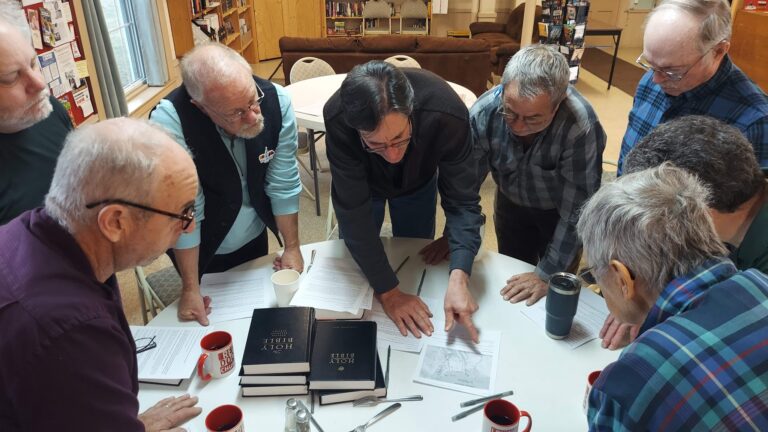
A hand went up in the back of the room, “What is that all about? I thought church was not supposed to be about politics,” she said. We were in a membership class and I was teaching about our church’s history and beliefs. Her hand went up after I referenced our church as an “evangelical” church. The class was a mixed group of some who had been Christians for a long time and just moved to the area, some who were returning to the faith of their childhood, and others were new to faith and were just beginning to learn some of the terminology. This woman explained that the only place she had ever heard this word was while listening to politics on TV or the radio.
I was not completely surprised. I recently read Evangelicals: Who They Have Been, Are Now, and Could Be (Eerdmans, 2019) and the opening line of the book by Mark. A. Noll declares: “The word ‘evangelical’ is in trouble…”[1] He goes on to mention “three crises” facing the term, the first of which appeared right there in that membership class that morning: the political connotations. If you just google “What is an Evangelical” you will find plenty of results that are political. Some even go as far now as to say that the “‘Evangelical’ now denotes political affiliation more than commitment to Christ.”[2] Because of this development, some suggest that the term should be shelved, at least when Christians are referring to themselves in a public context.[3] Others say the political connections that some associate with the term pertain to American politics, but evangelicalism is a transcontinental movement that is bigger than our political drama:
“Evangelicalism is a worldwide movement including as many as 30 percent of the people in the United States and hundreds of millions more around the world. Most international evangelicals today and throughout history have little or no knowledge of the details of American politics, Republicans, Democrats, Congress, courts or the White House. Most simply, they and we are people of faith who take the Bible seriously and believe in Jesus Christ as Savior and Lord.”[4]
Some will say that Christians have always been misunderstood in different ways across history, so the misunderstanding surrounding evangelicals is just more of the same. Early Christians were called “atheists” because they rejected the Greco-Roman gods. They were called “cannibals” because they ate the flesh and blood of their god. I remember listening to a Tim Keller sermon years ago and he was talking about how to one degree or another Christians will inevitably be misunderstood because the world’s categories are insufficient to capture the true essence of the Gospel. I think that’s right.
What’s At Stake?
Even though it is seems inevitable that Christians will continue to be misunderstood by outsiders, I do think it is important for Christians themselves to think hard about the labels they use. If we don’t understand the roots of our own churches and movements, how can we clarify terms when others ask, like the woman in our church’s membership class? How can we explain what we mean by the words we use? Or how can we truly know who we are?
I appreciate books like Four Views on The Spectrum of Evangelicalism in the Zondervan Counterpoints Series (2011) which is an effort to better understand the history and meaning behind the term. However, it reveals the fact that even within the Christian community itself there is significant disagreement about who the term should apply to. Can just anyone adopt the label? Christians from across the theological spectrum today adopt the term. Collin Hansen laments in the Introduction, “We are everything, so we are nothing.”[5]
So this post is my attempt to explain what we mean at Red Door Church when we use the term to describe ourselves.[6]
The Bebbington Quadrilateral
David W. Bebbington is a British historian who wrote Evangelicalism in Modern Britain: A History from the 1730s to the 1980s (Unwin Hyman, 1989). In that book he captured the essence of the evangelical movement in a way that theologian and President of the Southern Baptist Theological Seminary in Louisville (KY), Al Mohler, says “must be the most widely influential summary.”[7] Mohler quotes Bebbington’s description this way:
There are the four qualities that have been the special of Evangelical religion: conversionism, the belief that lives need to be changed; activism, the expression of the gospel in effort; biblicism, a particular regard for the Bible; and what may be called crucicentrism, a stress on the sacrifice of Christ on the cross. Together they form a quadrilateral of priorities that is the basis of evangelicalism.[8]
Mohler argues that they are sufficiently vague that they don’t solve the problem of evangelical identity and definition. I tend to agree. These four qualities accurately describe our faith at Red Door Church but with how willy-nilly the term “evangelical” is used today, even if we narrow it down some to these four qualities, they are not really giving a person much useful information about our beliefs.
Narrowing it Down
Evangelicals are Gospel people—”good news” people—for that is what the word itself means.[9] But contrary to the qualities in the Quadrilateral, the gospel is not a fuzzy thing but requires clear definition. Mohler asserts that evangelicalism must be defined not only by what characterizes its center but also by its boundaries. He suggests adding the four boundary markers listed below[10]. These certainly work well to better describe who we are at Red Door Church.
(1) The trustworthiness and truthfulness of Scripture. At Red Door Church we do not have merely “a particular regard for the Bible,” rather, we embrace the total truthfulness, trustworthiness, and authority of the Bible. Another way of saying this, we believe in biblical inerrancy. Without the Bible we have no way of knowing who Jesus really was, what he did, or what the gospel is.
(2) The exclusivity of the gospel. The gospel is not one of many ways to be right with God. Jesus is not one of many religious gurus who had a special connection to God. The message of the Scripture is clear: “And there is salvation in no one else, for there is no other name under heaven given among men by which we must be saved” (Acts 4:12). The Lausanne Covenant puts it this way: “Jesus Christ, being himself the only God-Man, who gave himself as the only ransom for sinners, is the only mediator between God and people. There is no other name by which we must be saved. All men and women are perishing because of sin, but God loves everyone, not wishing that any should perish but that all should repent. Yet those who reject Christ repudiate the joy of salvation and condemn themselves to eternal separation from God.” For the full statement, see the footnote below.[11]
(3) The integrity of Theism. In recent years there has arisen a movement within evangelicalism to revise our understanding of historic theism. Take the “openness of God” movement, which denies the omniscience of God, as just one example. But at the very heart of Christianity lies a distinctive kind of theism that is Trinitarian, and has always affirmed that God is infinite in all of his attributes, including his omniscience. Take the Westminster Larger Catechism Q&A 7, as an example:
Q. 7. What is God?
A. God is a Spirit, in and of himself infinite in being, glory, blessedness, and perfection; all-sufficient, eternal, unchangeable, incomprehensible, everywhere present, almighty, knowing all things, most wise, most holy, most just, most merciful and gracious, long-suffering, and abundant in goodness and truth.[12]
If we compromise foundational elements of God’s very nature, the very structure is doomed to collapse. At Red Door Church we hold to the traditional, historic, creedal, classical understanding of God.
(4) The nature of Justification and the Atonement. When a person is saved, the Bible teaches repeatedly that it is by faith in Christ alone, not by any works done by us. We are justified (declared righteous) by faith in the Righteous One, Jesus, not by our own efforts or goodness (Romans 5). Moreover, Christ’s sacrifice was not merely an example or demonstration of love, it was substitutionary. Jesus took our place, the just for the unjust, so that he might bring us to God (1 Peter 3:18).
Do these describe the sum total of evangelicalism? No, but at Red Door Church we are much closer to this version than to the “evangellyfish” version that describes much of broader evangelicalism.
What Do We Do?
When we are misunderstood or mislabeled what do we do? When others who don’t truly represent us adopt our brand, what do we do? Leith Anderson with the National Association of Evangelicals asks that same question, and I like his answer:
So, what are we supposed to do? Take a page from the early church when Nero disparaged, persecuted and martyred “Christians.” In the turmoil of first century Roman politics, Christians were called traitors. They were blamed for burning Rome by the emperor who probably set the fires himself. Did they abandon the name Christian? Some probably did. Labels aren’t always helpful and change with circumstances. St. Peter gave the best advice in the worst of times: “Live such good lives among the pagans that, though they accuse you of doing wrong, they may see your good deeds and glorify God on the day he visits us” (1 Peter 2:12). [13]
[1] Mark A. Noll., David Bebbington, & George M. Marsden, Evangelicals Who They Have Been, are Now, and Could Be (William B. Eerdmans, Grand Rapids, 2019), 1.
[2] Erin Sentell, “Is ‘Evangelical’ a Political Term Now? Pew Research Suggests So,” at https://medium.com/backyard-theology/is-evangelical-a-political-term-now-e28a070c80f5. Accessed 9/21/26.
[3] Thomas Kidd, “Is the Term ‘Evangelical’ Redeemable?” at https://www.thegospelcoalition.org/blogs/evangelical-history/is-the-term-evangelical-redeemable/. Accessed 9/21/26.
[4] Leith Anderson, “Evangelical-Political,” at https://www.nae.org/evangelical-political/. Accessed 9/21/26.
[5] Kevin Bauder, et. al. Four Views on The Spectrum of Evangelicalism (Zondervan, Grand Rapids: 2011), 73.
[6] Of course, I recognize that there are people within our membership roles that would not necessarily agree with every point as its explained here. My goal is to explain what our pastor and elders hold to and our congregation, generally.
[7] Al Mohler, “Confessional Evangelicalism,” in Four Views on The Spectrum of Evangelicalism (Zondervan, Grand Rapids: 2011), 73.
[8] As quoted in Al Mohler, “Confessional Evangelicalism,” in Four Views on The Spectrum of Evangelicalism (Zondervan, Grand Rapids: 2011), 73.
[9] “Evangelicals take their name from the koine Greek word euangelion, translated into English as ‘good news.'” Kevin Bauder, et. al. Four Views on The Spectrum of Evangelicalism (Zondervan, Grand Rapids: 2011), 10.
[10] Al Mohler, “Confessional Evangelicalism,” in Four Views on The Spectrum of Evangelicalism (Zondervan, Grand Rapids: 2011), 89-94.
[11] “We affirm that there is only one Saviour and only one gospel, although there is a wide diversity of evangelistic approaches. We recognize that everyone has some knowledge of God through his general revelation in nature. But we deny that this can save, for people suppress the truth by their unrighteousness. We also reject as derogatory to Christ and the gospel every kind of syncretism and dialogue which implies that Christ speaks equally through all religions and ideologies. Jesus Christ, being himself the only God-Man, who gave himself as the only ransom for sinners, is the only mediator between God and people. There is no other name by which we must be saved. All men and women are perishing because of sin, but God loves everyone, not wishing that any should perish but that all should repent. Yet those who reject Christ repudiate the joy of salvation and condemn themselves to eternal separation from God. To proclaim Jesus as ‘the Saviour of the world’ is not to affirm that all people are either automatically or ultimately saved, still less to affirm that all religions offer salvation in Christ. Rather it is to proclaim God’s love for a world of sinners and to invite everyone to respond to him as Saviour and Lord in the wholehearted personal commitment of repentance and faith. Jesus Christ has been exalted above every other name; we long for the day when every knee shall bow to him and every tongue shall confess him Lord.” (As stated in the Lausanne Covenant, Section 3, on the Uniqueness and Universality of Christ. See https://lausanne.org/statement/lausanne-covenant. Accessed 9/22/26.)
[12] The Westminster Larger Catechism can be read in its entirety here: https://thewestminsterstandard.org/westminster-larger-catechism/. Accessed 9/22/26.
[13] Leith Anderson, “Evangelical-Political,” at https://www.nae.org/evangelical-political/. Accessed 9/22/26.