Our Sunday School program is a form of catechesis, or Christian training. At Red Door Church, our Sunday School program takes into account methods that are Biblically faithful, historically accepted, and contextually sensitive.
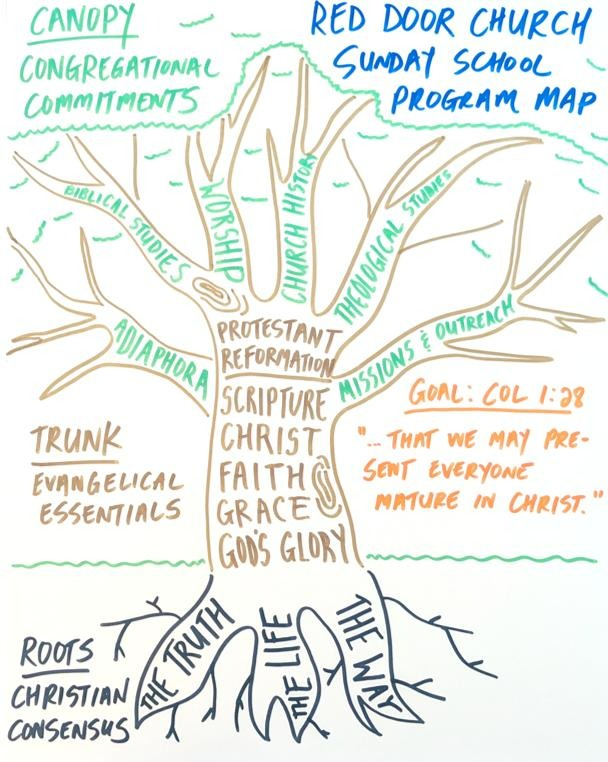
Our program takes the concept found in Psalm 1—a believer being like a tree planted next to the streams of water—and developed it into a model for our Sunday School program. The model represents three basic tiers of catechesis. The first level or tier is called “Roots,” the second tier is called “Trunk,” and the third tier is called “Canopy.” Each tier is explained in the next pages.
The seed from which the entire tree grows, and the soil in which it grows, is Scripture. 1 Peter 1:23 says, “since you have been born again, not of perishable seed but of imperishable, through the living and abiding word of God…” Every class done in the Red Door Church Sunday School program will be rooted in Scripture.
The Roots
The “Roots” is the foundational, or most important, of the three tiers of catechesis. If we get this wrong, everything that follows will be unstable, or to keep with the analogy, the tree will be deformed or vulnerable to blight. However, if we get the roots right, the tree will be healthy, will provide shade, and the birds of the air can come and make their nests.
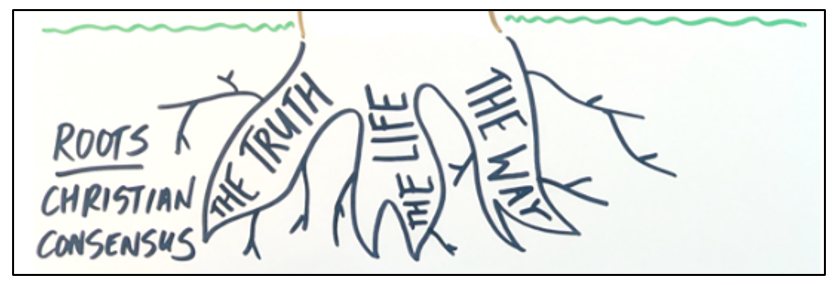
The roots tier of catechesis will consist of classes that are foundational to everything that follows. It is based on the practice of the historic church across the centuries. These ideas are not the unique ideas of your pastor or church elders; they represent “Christian Consensus,” or what the church has agreed upon as most fundamental to the faith for nearly two thousand years.
As scholars, Packer and Parrett show in their book Grounded in the Gospel, thoughtful teachers and theologians from across the centuries have seen three, and sometimes four, basic elements to the foundational instruction of believers: the Creed, the 10 Commandments (Decalogue), the Lord’s Prayer, and the Sacraments (Baptism and the Eucharist). In the words of the Anglican Catechism In Outline:
“From the time of the early church, faith, hope, and love (‘the three that remain,’ 1 Corinthians 13:13) have underpinned the catechetical structure. The Creed, the Lord’s Prayer, and the Ten Commandments became the basis for expounding these three respective doctrines.”
The chart below shows how this pattern of training has been used for centuries. The column in grey shows the name of the tool and the year it was written/published in parentheses. Some of the tools taught the elements in different order, represented by the numbers in parentheses in each column.
| Apostles’ Creed | Decalogue | Lord’s Prayer | Sacraments | |
|---|---|---|---|---|
| Acts 2:42 | The teaching of the apostles (1) | The fellowship (2) | The prayers (3) | The Lord’s Supper (4) |
| Augustine’s Enchiridion (420) | Faith (1) | Love (2) | Hope (3) | |
| Baxter’s use of three formulae (1683) | Doctrine of faith (1) | Law of our practice (2) | Matter of our desires (3) | |
| Catechism of the Catholic Church (1992) | Profession of Faith (1) | Life in Christ (3) | Christian Prayer (4) | Celebration of the Mystery (2) |
| Growing in Christ (Packer, 1994) | Affirming the essentials: Convictions (1) | Design for the life: Code of conduct (4) | Learning to pray: Communion with God (3) | Entering in: Covenanting in baptism: conversion, commitment, and church life (2) |
| Anglican Catechism in Outline (2008) | Faith: new foundation/the Nicene Creed (1) | Love: prepared for good works/the Decalogue (3) | Hope: new identity and calling/the Lord’s Prayer (2) | |
| This chart was taken from Packer and Parrett in Grounded in the Gospel (87). | ||||
These common threads will form the foundation or “roots” of our program. All studies that are classified as roots will be foundational studies either looking directly at the Creed, the Prayer, or the Commandments. In our tree “map,” this is represented by the three major roots pictured: The Truth (Creed), The Life (Prayer), and The Way (Commandments).
The Trunk
The “Trunk” tier of our catechesis represents the next level of training. This level is built upon the previous and requires some basic understanding of what went before in order to fully benefit from the teaching. That is not to say that you must attend the Roots classes before coming to the Trunk studies. However, if one does not have a grasp on the foundational truths of Christianity (the Roots), classes in the Trunk tier or Canopy tier will be harder to follow.
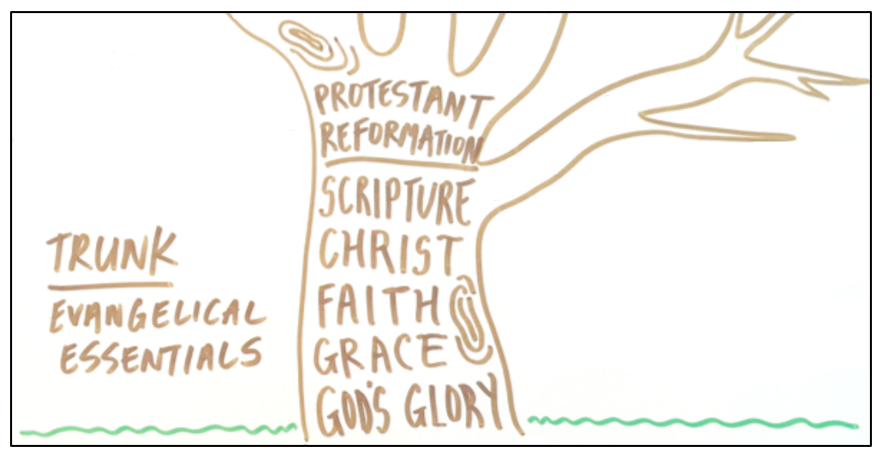
Red Door Church is a distinctly Protestant, Evangelical church (even though, technically, we are non-denominational). The Trunk level focuses on what we might call “Evangelical Essentials.” In these classes, we will learn about what it means to be Protestant and Evangelical. We will talk about the Protestant Reformation and the Five Solas. We will discuss the four evangelical values of the Bebbington Quadrilateral (diagram below). We will discover how the Protestant Reformation was a retrieval of the ancient teaching of the church, not an invention of new doctrine.
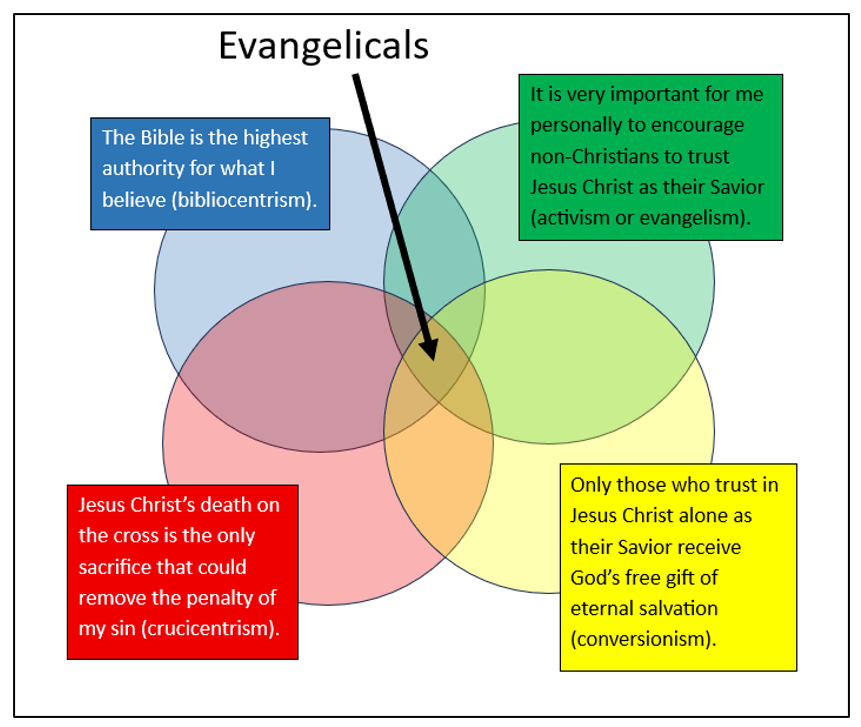
Of course, as stated earlier, all of these classes will keep Scripture central. One of the primary teachings of the Reformation is what is called Sola Scriptura (Scripture Alone), which teaches that Scripture is the only infallible rule of faith and practice. In other words, Scripture was the norming norm, the plumb line for all of the church’s teaching. We will seek to ground everything in holy Scripture as we study these important topics.
The Canopy
The “Canopy” represents the third, or highest tier of our Sunday School catechesis. These classes fall into two categories: they are either studies that are built upon previous classes or they are electives.
For example, the class on Islam (scheduled for January and February of 2027) is a short elective-style class. Even though it is an “Introduction,” it is in the Canopy tier because it is not considered “foundational” (Roots) or “essential” (Trunk).
Another example of a Canopy class might be a study of the worship of the Church. We would look at questions like: What do the Scriptures say about gathered worship? What is liturgy? Why do we do what we do when the Church gathers? Are there other legitimate ways to worship God? In order to truly benefit from this course, having some of the Roots and Trunk classes under your belt will prove immensely useful.
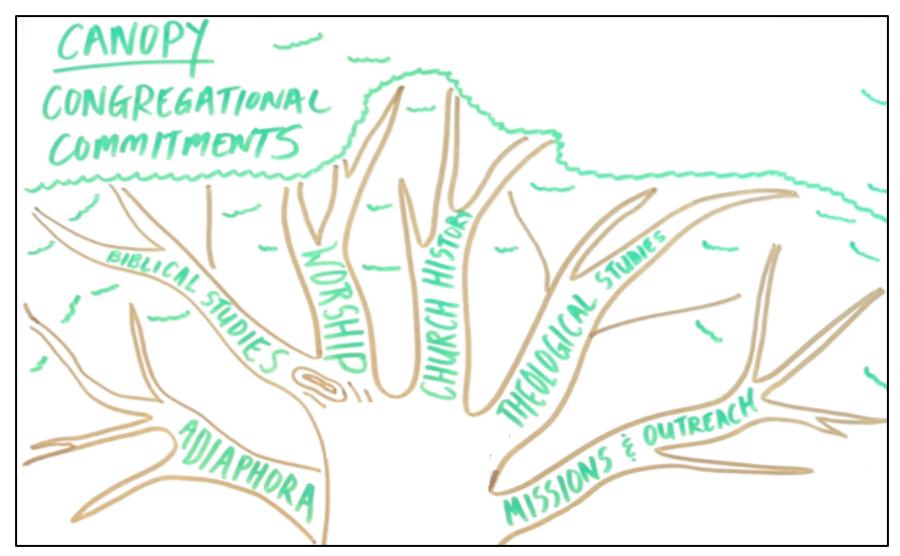
Many of the studies that fall under the Canopy tier involve what we might call “Congregational Commitments.” This refers to those things that separate us from some other Protestant Evangelical churches. Of course, not everyone in our church will agree with the things discussed in this section (and perhaps even some things in the Trunk tier). The Canopy studies that the elders choose to offer would generally relate to things that they feel our particular church needs to better understand, or grow deeper into. Sometimes that may involve a deeper dive into an essential doctrine of the Church, like the Resurrection.
The large branches in the Canopy diagram represent various subcategories of studies that would fall under this tier.
Adiaphora. Adiaphora is a Greek word that means “things indifferent.” Studies in this category are what we might call non-essentials of the faith. These topics are numerous and pertain to matters that Christians can legitimately disagree with and still call one another brother and sister (see Romans 14). During these studies, the pastor and elders will often advocate for their particular stance on a matter, while respecting the fact that there are other legitimate viewpoints.
Biblical Studies. In one sense, every study we do in the Sunday School program is a Biblical study because we will be wrestling with what the Bible says on every issue. What is meant here, though, is more specific. An example of a study that would fall under this category would be “15 weeks in the book of Romans,” or “How did we get the Bible?” or maybe “How Did the Writers of the New Testament Use and Interpret the Old Testament?”
Worship. This branch relates to all things pertaining to worship. A class in this section may do a study on the Liturgy of the Church or the Regulative Principle of Worship, or perhaps a study on the Sacraments of the Church.
Church History. Studies related to Church History. Many of the classes in the Sunday School program will have a historical element to them. For instance, “How did we get the Bible” (mentioned above) will discuss some of the history behind the writing and assimilation of the Biblical books, or a study of worship would involve some history, looking at different practices across the centuries.
Theological Studies. In some way, every Sunday School class is theological. We like Luce and Williams’ definition of theology: “the application of God’s revelation to all of life” (from their book How to Teach Kids Theology, 18). Classes that fall under this branch might be “How Do Free Will and God’s Sovereignty relate?” or “The Differences Between Roman Catholics and Protestants” or “10 Weeks on the End Times.”
Missions and Evangelism. This branch will involve studies on world religions and other faiths or cults, how to share your faith with others, or maybe a study on a particular missionary person or movement. In these classes (and in some others) we may do group activities and practice evangelistic methods with one another.