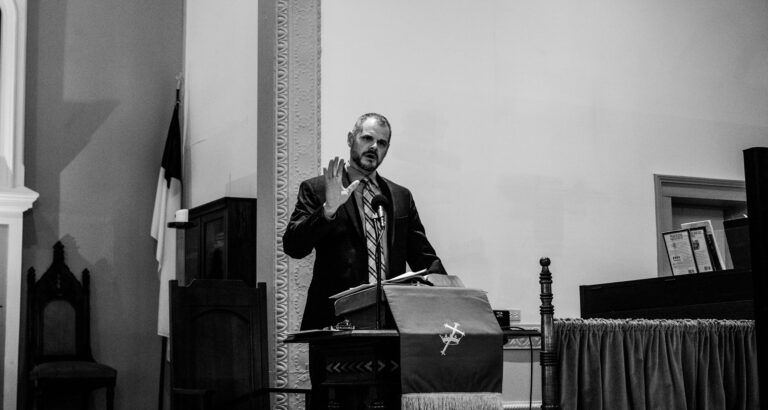
At significant moment’s in our lives it is appropriate and even expected to take time to reflect upon the past, celebrate the present, and look with hope and anticipation into the future. Every year we do just that at our annual Baccalaureate service at Red Door Church.
But what is a Baccalaureate service?
The Meaning of the Word
Lewis and Clark College has a helpful article about the Baccalaureate ceremony on their website. They explain the meaning of the word:
The odd name, baccalaureate, comes from the early years of higher education when the bachelor’s degree was called “the baccalaureate.” It is believed that, during the 15th century, Oxford University established a tradition of sending their graduates off through a (very) long service that included sermons offered in Latin. When this tradition was carried to the United States the ceremony was changed and the distinctly religious aspects of the ceremony were encompassed in a service before Commencement. That service came to be called “Baccalaureate.” The word began as baccalaureus , (bachelor), and was altered to bacca lauri , (laurel berry) to mirror the bay tree leaves that were woven into crowns to be placed on the heads of scholars.[1]
Of course the word “baccalaureate” is also, at times, applied to other educational activities and programs in American high-schools. Just to give one example, in the Charlotte-Mecklenburg School System (NC), where I went to high school, they have an “International Baccalaureate” program that they describe this way:
The IB program is a comprehensive program of study that focuses on critical thinking and international mindedness. The program seeks to develop the whole child — intellectually, personally, socially and emotionally — through teaching of cultural understanding, language development and volunteerism. Designed to reinforce a positive attitude, the program teaches students to ask challenging questions, reflect critically, develop research skills and become active learners. The continuum of education spans the years from Kindergarten to grade 12.[2]
The History of the Baccalaureate Service
There is some uncertainty surrounding the exact origins of the Baccalaureate service. However, Columbia University has a helpful blurb that mentions some of the known history of the service:
The Baccalaureate Service is believed to have originated at Oxford University in 1432 when each bachelor was required to deliver a sermon in Latin as part of his academic exercise. This historical British practice continued with the earliest universities in this country, which were founded primarily to educate ministers. Columbia University began this tradition in 1897 and the ceremony continues today…[3]
Because most of the early universities were born out of a desire to educate and train ministers, the baccalaureate address was often highly religious or apologetic in nature. The listeners were instructed to live moral lives in keeping with their Christian profession and expected to teach others to do likewise. In this way, the baccalaureate speech was different from the commencement address which gave the speaker more latitude to speak academically or in a mere motivational manner.[4]
What is a Baccalaureate Service Today?
Today, you can bet your house that there will be no Latin sermons being delivered at a Baccalaureate service (or powdered wigs)! As mentioned at the top of this article, when the service came to the United States many things about it began to change. Today, schools like Yale substitute the sermon with an address from the school’s President.[5] Many became interfaith or non-denominational.[6]
Queens College in Charlotte describes the evolution of the Baccalaureate service this way:
With its roots in a 15th-century Oxford University tradition of graduating students giving “sermons” before their send-off, Baccalaureate has evolved to become a ceremony that marks the end of a student’s educational journey in a way that is more religious or spiritually oriented than Commencement. Baccalaureate typically features readings from scripture, musical selections, prayers of blessing and gratitude, and reflections on the deeper meaning and significance of education by students, faculty, and staff. The ceremony is open to those of all faith traditions—or none at all—who desire to pause, reflect, celebrate, and be inspired at this important moment in a graduate’s life. All graduating students and their guests are invited to attend.[7]
Below are a couple of modern examples of how schools frame their Baccalaureate services. A High School in Washington state says this:
The term generally refers to a non-denominational ceremony held a few days before high school or college graduation. Unlike the massive commencement exercises held in stadiums or arenas, baccalaureate ceremonies offer a quieter, more intimate opportunity to pause and reflect on this rite of passage, hear a keynote speaker, a faculty member and student speakers offer advice to the graduating class and enjoy students’ musical talents.[8]
Wake Forest University describes their Baccalaureate service this way:
Baccalaureate, a one-hour religious service held inside Wait Chapel, honors the graduating class. During the service, an address in the form of a sermon is delivered by a faculty member or respected leader in the religious community.[9]
Red Door Church’s Baccalaureate Service
Our Baccalaureate service at Red Door Church is intended to be a time of celebration for what these young people have accomplished and also a time of inspiration. We invite local Christian pastors, community leaders, and usually a representative from the school (usually a teacher or principle) to share “words of wisdom” with the graduates. There is music and special readings, sometimes poetry or speeches written by graduates from the White River Valley School. The people of Red Door Church put together gift bags with notes and personalized mementos for each graduate. After the service there is a time of fellowship and refreshments.
We are honored to be working with the students of White River Valley School and other community leaders to put together a service that will be a treasured memory in the lives of the students, their friends, and family for many years to come.
[1] See https://college.lclark.edu/commencement/baccalaureate-celebration-faqs/. Accessed March 24, 2026.
[2] See https://www.cmsk12.org/academics/school-choice/international-baccalaureate. Accessed March 24, 2026.
[3] See https://commencement.columbia.edu/content/baccalaureate-service. Accessed March 24, 2026.
[4] See https://www.renewanation.org/post/the-birth-and-death-of-the-baccalaureate-address. Accessed March 24, 2026.
[5] https://commencement.yale.edu/what-happens-baccalaureate. Accessed March 24, 2026.
[6] Princeton University is one example, describing their service this way: “Baccalaureate is an interfaith service, reflecting the diversity of religious life at Princeton University. The service features a guest speaker and is a celebration focused especially on the members of the senior class — those receiving bachelor’s degrees. The Baccalaureate address is one of the University’s oldest traditions. Speakers at Baccalaureate are chosen for their capacity to speak on topics related to human values, broadly considered.” See https://www.princeton.edu/events/2024/baccalaureate-ceremony. Accessed March 24, 2026. Williams College is another example of this. See https://commencement.williams.edu/about-the-events/baccalaureate/, Accessed on March 24, 2026. Also Columbia describes their service as “an interfaith, intercultural service celebrating each undergraduate’s academic career.” See https://commencement.columbia.edu/content/baccalaureate-service. Accessed March 24, 2026.
[7] See https://www.queens.edu/spirituallife/baccalaureate/. Accessed March 24, 2026.
[8] See https://ehs.lwsd.org/. Accessed March 24, 2026.
[9] See https://commencement.wfu.edu/family-and-guest-information/baccalaureate-service/. Accessed March 24, 2026.